Posts

Fitting TOCSY (2D 1H NMR) Data with Mathematica

Image
So this isn't so much "fitting" as it is programming in known data points and then making a function that easily allows one to switch between different inputs until one that is close enough is identified visually. It could be substantially improved by adding peak detection and error calculations. For one of my classes, Ch 007, my lab partner and I used solid phase synthesis techniques to make a pentapeptide incorporating four known peptides (one of which is non canonical) and an unknown mystery peptide in a known order. Solid phase techniques are generally known for their extremely high yields. Given that it was my first go at the technique I think I might have played a key role in obtaining a much lower than expected yield. Nevertheless, the product was purified by prep HPLC and the result was rather pure in the 1H NMR spectrum. We obtained a TOCSY 2D spectrum and are now tasked with interpreting the TOCSY spectrum as well as ESI-MS and MALDI-MS to verify the structur...
Modelling a Magnetic Cube: Dipoles!

Image
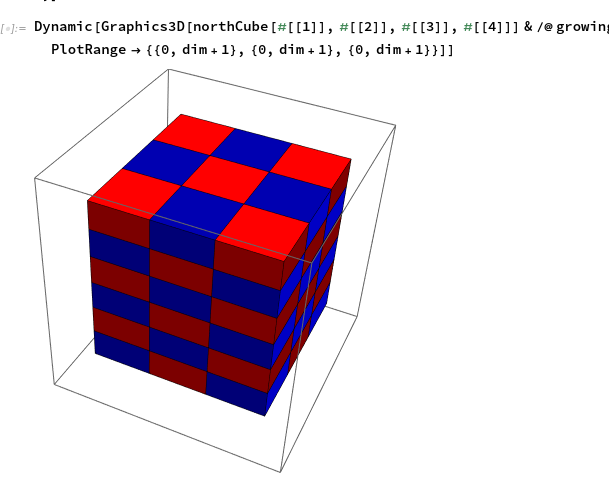
So I found this paper    https://doi.org/10.1063/1.4941750  (It's open access by the way) and in it they have a nice equation for the energy between two magnetic dipoles. $$E_{m_{1}m_{2}} = \frac{1}{4\pi\mu}\frac{m_{1}m_{2}-3(m_{1}e_{r})(m_{2}e_{r})}{|l^{3}|}$$ In it, the terms m1 and m2 describe the dipole vector of each magnet, and er describes the normal vector between the centers of each dipole, l describes the distance between the two dipoles, and mu is the permeability of the medium. For our purposes I got rid of mu because it's just a scaling factor. With dipoles the determination of the energy becomes a little more complicated because I've got to permute through all the possible orientations of the magnets in order to find the best choice for moving to a lower energy. This is simplified greatly by the fact that the magnets in this case are cubes and so can only have six possible orientations. In the code I've described this with an integer (1 to 6...

Modelling a Magnetic Cube: Optimizing an 8x8 grid of Monopoles

Image
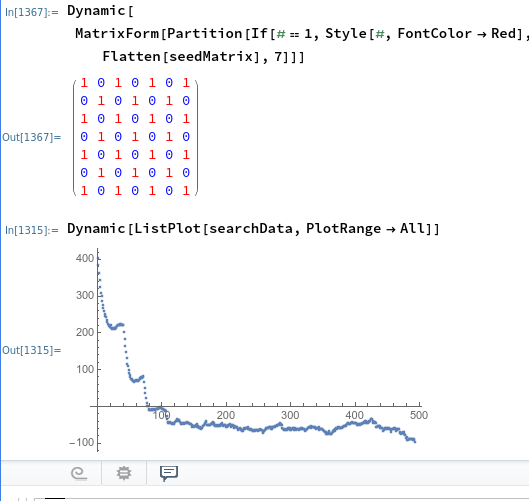
I was quite excited by the result obtained in the previous post from this series. However after acheiving it I realized that although I could propose a configuration and illustrate its energy distribution it was pretty much useless for finding what the minimum energy configuration of an arbitrary arrangement of positions each containing a monopole is. In order to find the energetic minimum, one could in theory simply characterize the entire state space of a configuration. Since there are two possible monopoles that can occupy a position the size of the state space is 2^N for N positions. Obviously for an 8x8x8 cube that is 13,407,807,929,942,597,099,574,024,998,205,846,127,479,365,820,592,393,377,723,561,443,721,764,030,073,546,976,801,874,298,166,903,427,690,031,858,186,486,050,853,753,882,811,946,569,946,433,649,006,084,096 possible configurations. I don't think I have the resources to characterize the whole state space so we need a more efficient way of finding the energetic m...

Modelling a Magnetic Cube: Monopoles

Image
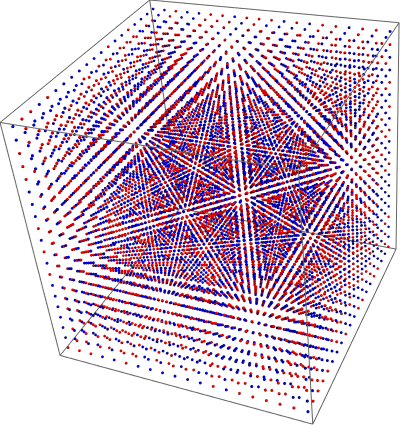
I took an interesting course this past term on biochemical computation. It's taught by Erik Winfree who was one of the first to identify that DNA strands can be used to model computation. On one of the homework assignments it was announced that the best solution would get a prize at the end of the term. Although I did not get first play, my solution was "within epsilon of winning" and so I too got a first place prize. The prize was an 8x8x8 cube of small cubes of neodymium cubic magnets. The cube was all well and good before I began dissassembling it but when the task of reassembling the cube came up I realized that although it was tauted as a "self assembling" cube, actually getting it to its most stable configuration is quite challenging. The easiest way of doing it is to make a one dimensional chain of cubes and then fold it into an 8x64 rectangle with the poles oriented parallell with the short side, then folding this rectangle into a cube. I can see why th...

RTL-SDR NOAA satellite Images

Image
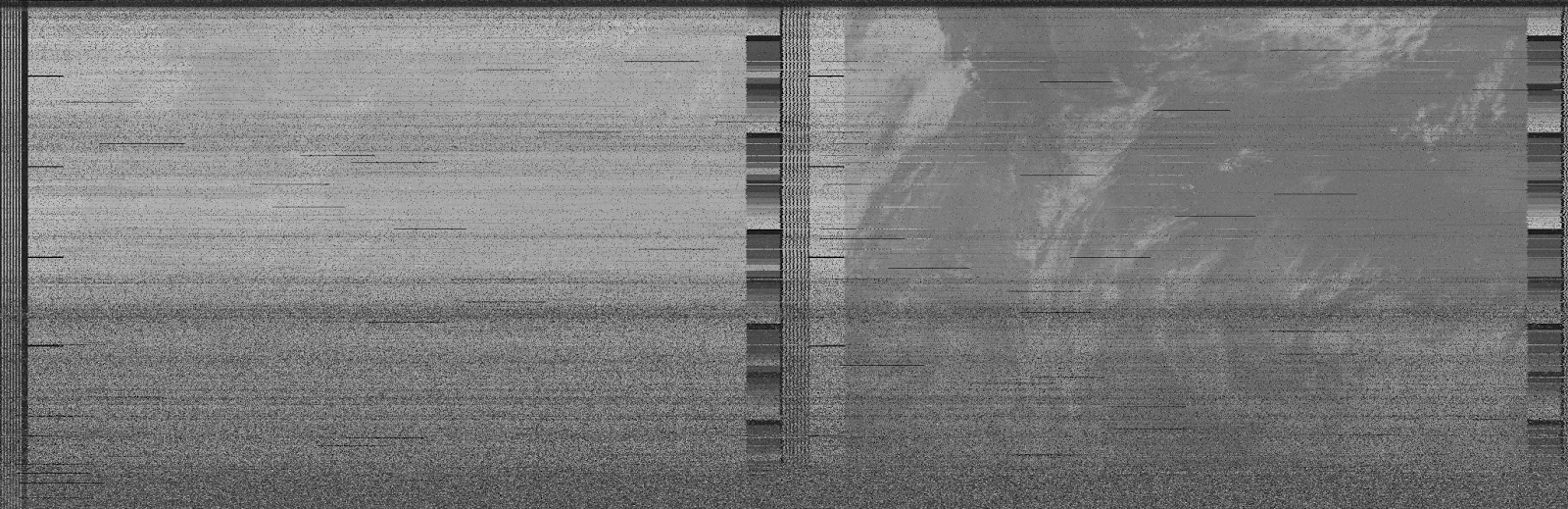
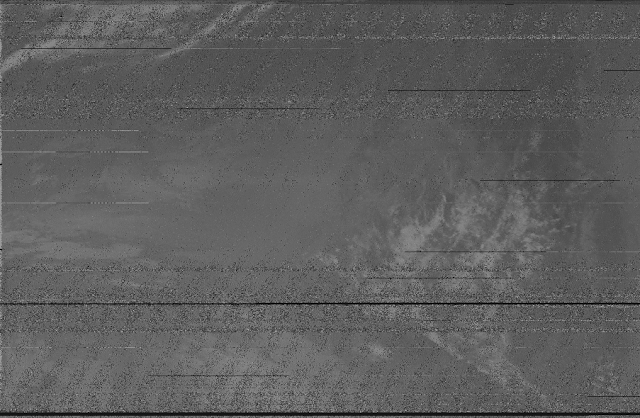
Turns out most of my other images were actually images produced from signals that were not NOAA signals, whoops. Here are some images I managed to get here at Caltech. Our good friends at the local NPR station (KPCC 89.3) over at Pasadena Community College as well as all the other radio noise here are not helping the quality of the images. I need to frequently adjust the antenna orientation to try and block out the differently polarized signals and to only get the circularly polarized satelite signal. I'm using a QFH tuned (very roughly tuned) to 137 MHz.

Amature Radio with an RTL-SDR 2

Image
This is part 2 to my adventure into amature radio receiving. I conveyed my intention to receive images from NOAA satellites in the first part. I was unable to replicate the results of the possible image, despite the construction of a 137 MHz V-dipole antenna (albeit probably not the best antenna since I am not experienced in antenna construction). Tomorrow I'll try building the antenna detailed here . Hopefully that will give me sufficient signal intensity to receive visually recognizable images. The other complicating factor is I'm uncertain how to match the default 11.250kHz sampling of the audio input file in wxtoimg with the 44.1kHz sampling of audio by CubicSDR and then the 44.1kHz sampling of the recording program. I did change the wxtoimg sampling to 44.1kHz however any potential image was distorted beyond the ability of wxtoimg to overlay a map upon it. I'll update you tomorrow (I guess whenever I say tomorrow in this post I mean today since it's past midnight)...

Microstate table for a d3 electronic configuration.

This was just a test to see if I could put LaTeX formatted tables into this webpage MathJax example $$\begin{array}{|c | c | c | c | c|} \hline \begin{array}{c}\end{array} & \frac{3}{2} & \frac{1}{2} & -\frac{1}{2} & -\frac{3}{2} \\ \hline 5 & \begin{array}{c}\end{array} & ^{2}H\begin{array}{c}^{2}H(2^+,2^-,1^+)\end{array} & \begin{array}{c}(1^-,2^-,2^+)\end{array} & \begin{array}{c}\end{array} \\ \hline 4 & \begin{array}{c}\end{array} & ^{2}G\begin{array}{c}^{2}H(2^+,2^-,0^+)\\^{2}G(2^+,1^+,1^-)\end{array} & \begin{array}{c}(0^-,2^-,2^+)\\(1^-,2^-,1^+)\end{array} & \begin{array}{c}\end{array} \\ \hline 3 & ^{4}F\begin{array}{c}^{4}F(2^+,1^+,0^+)\end{array} & ^{2}F\begin{array}{c}^{2}H(2^+,2^-,-1^+)\\^{2}G(2^+,1^+,0^-)\\^{4}F(2^+,1^-,0^+)\\^{2}F(2^-,1^+,0^+)\end{array} & \begin{array}{c}(1^-,2^-,0^+)\\(0^-,2^-,1^+)\\(0^-,1^-,2^+)\\(-1^-,2^-,2^+)\end{array} & \begin{array}{c}(0^-...